

Wills & Estates6 min read
What Happens If You Die Without a Will in Alberta
Harman ChahalAssociate Lawyer
May 22, 2026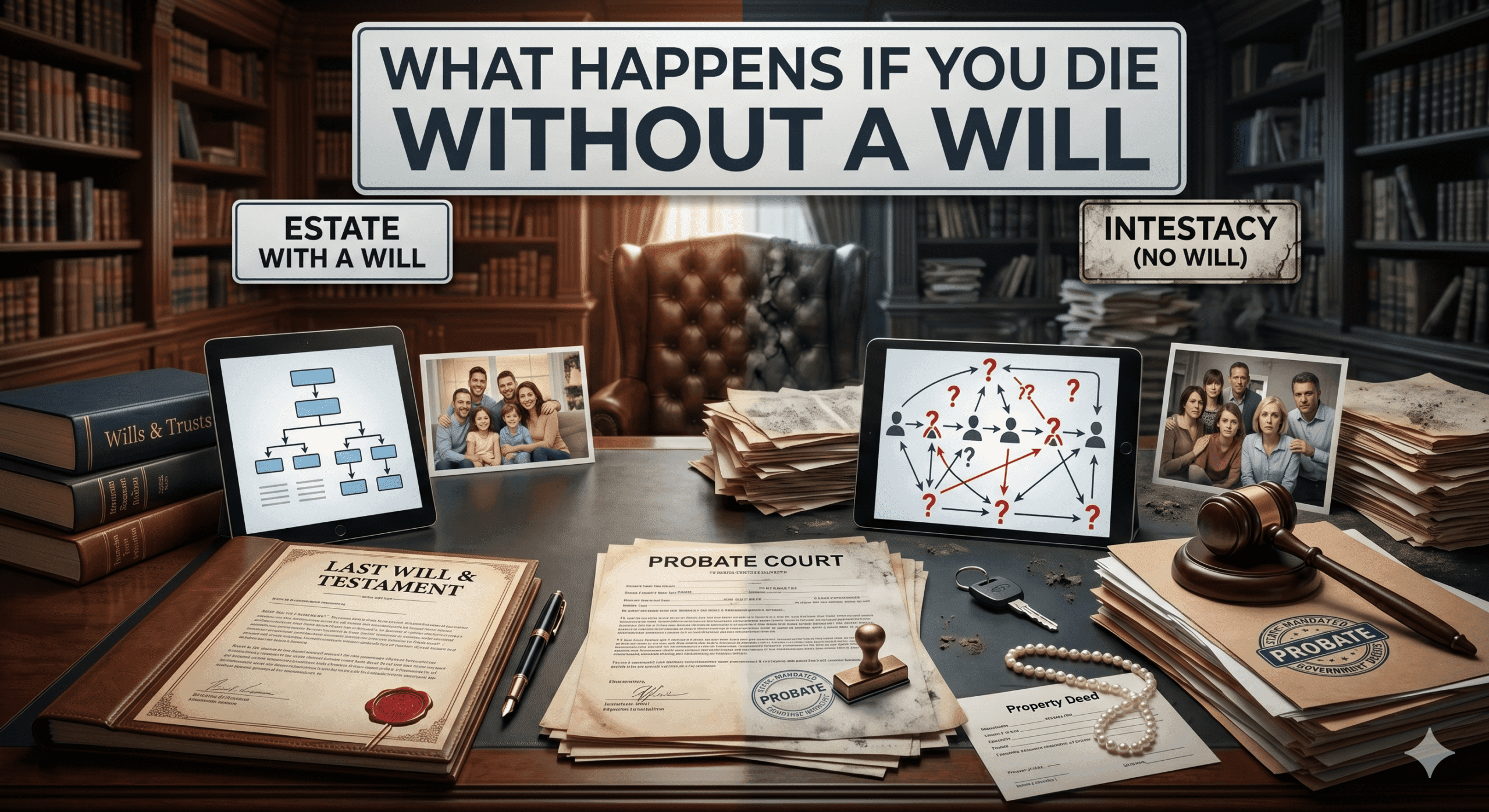
If you die without a will in Alberta, the law decides who receives the part of your estate that does not otherwise pass by joint ownership, beneficiary designation, or another estate planning tool. This is called dying intestate.
For many families, intestacy can create confusion, delays, and stress at an already difficult time. Without a will, there is no written record of who you wanted to manage your estate, who you wanted to inherit your assets, or who you wanted to care for minor children.
Alberta’s Wills and Succession Act sets out who inherits when someone dies without a valid will. The outcome depends on your family situation at the time of death, including whether you had a spouse, an adult interdependent partner, children, grandchildren, or other relatives.
What Does It Mean to Die Intestate?
A person dies intestate when they pass away without a valid will.
When this happens, two main issues usually come up.
First, no executor has been named. Someone may need to apply to the court to be appointed as the estate administrator before they can deal with estate assets, pay debts, or distribute property.
Second, there are no written instructions about how the person wanted their estate distributed. Instead, Alberta’s intestacy rules decide who inherits after debts, taxes, and estate administration expenses are handled.
Who Inherits If You Die Without a Will in Alberta?
The answer depends on your family structure.
It is also important to remember that intestacy rules only apply to assets that form part of your estate. Some assets may pass outside the estate, such as jointly owned property with a right of survivorship or accounts with valid beneficiary designations.
If You Have a Spouse or Adult Interdependent Partner and No Children
If you die with a spouse or adult interdependent partner and no descendants, your spouse or partner generally receives the portion of your estate governed by intestacy rules.
Parents and siblings do not automatically share the estate with your spouse simply because you died without a will.
If You Have a Spouse or Partner and Children From the Same Relationship
If you die with a spouse or adult interdependent partner, and all of your children or grandchildren are also descendants of that spouse or partner, your spouse or partner generally receives the portion of your estate governed by intestacy rules.
This is an important point because many people assume the estate is automatically split between the spouse and children. In Alberta, that is not usually the case when all descendants are from the same relationship.
For example, if a married couple has children together and one spouse dies without a will, the surviving spouse will usually inherit the estate under Alberta’s intestacy rules.
| Free Download: Estate Planning Checklist |
|---|
If You Have a Spouse or Partner and Children From Another Relationship
The rules are different in blended-family situations.
If you die with a spouse or adult interdependent partner and you also have descendants who are not descendants of that spouse or partner, your spouse or partner generally receives the greater of:
- $150,000, or
- 50% of the net value of the intestate estate.
The rest goes to your descendants, usually by what is called per stirpes distribution.
This is where the statutory amount matters. It does not apply as a general rule in every spouse-and-children situation. It is mainly relevant when there are descendants from another relationship.
For example, if someone dies with a current spouse and children from a previous relationship, both the spouse and children may have a right to share in the estate. The exact distribution depends on the value of the estate and the family structure.
If You Have Children But No Spouse or Partner
If you die without a surviving spouse or adult interdependent partner, your estate generally goes to your descendants.
This includes children and, in some situations, grandchildren. If one of your children passed away before you but left children of their own, those grandchildren may inherit their parent’s share.
If You Have No Spouse, Partner, Children, or Grandchildren
If there is no surviving spouse, adult interdependent partner, or descendants, the law looks to other relatives in priority order.
This may include:
- parents;
- siblings, nieces, or nephews;
- grandparents or their descendants;
- great-grandparents or their descendants.
Parents and siblings generally become relevant when there is no spouse or partner and no descendants.
What Is an Adult Interdependent Partner?
In Alberta, an adult interdependent partner can have inheritance rights similar to a married spouse.
An adult interdependent relationship may exist where two people have lived together in a relationship of interdependence for at least three years, have a relationship of some permanence and a child together, or have entered into an adult interdependent partner agreement.
Not every dating relationship or short-term living arrangement qualifies. Some situations can also be more complex, including where there may be both a legal spouse and an adult interdependent partner. In those cases, legal advice is especially important.
What If You Are Separated But Not Divorced?
Separation can affect inheritance rights in Alberta.
It is not always accurate to say that a separated spouse automatically inherits just because there has not been a divorce. In some legally recognized separation situations, a surviving spouse may not inherit under Alberta’s intestacy rules.
For example, separation may be relevant where spouses lived separate and apart for more than two years at the deceased’s date of death, were named in a declaration of irreconcilability, or signed an agreement showing an intention to end the marriage.
Because separation issues can be fact-specific, it is important to speak with a lawyer instead of relying on assumptions.
Does Dying Without a Will Avoid Probate?
No. Dying without a will does not avoid the court process.
In fact, it can make things more complicated because there is no executor named in a will. Someone usually has to apply to the court for authority to administer the estate. This person is called an administrator.
Until the court gives that authority, no one may have legal power to sell assets, pay debts, close accounts, or distribute money to beneficiaries.
With a properly prepared will, you can name the person you trust to act as your executor.
Assets That May Pass Outside the Estate
Not every asset automatically passes through the estate.
Some assets may pass outside the estate if they are set up properly. This can include:
- life insurance with a named beneficiary;
- RRSPs with a designated beneficiary;
- RRIFs with a designated beneficiary;
- TFSAs with a successor holder or designated beneficiary;
- pension benefits with a named beneficiary;
- jointly owned property with a right of survivorship.
For example, life insurance may be paid directly to a named beneficiary instead of being distributed under intestacy rules. Similarly, some registered accounts, such as RRSPs, RRIFs, and TFSAs, may pass directly to a named beneficiary or successor holder.
However, these designations need to be reviewed regularly. Problems can happen if no beneficiary is named, the beneficiary has passed away, the estate is named as beneficiary, an ex-spouse or former partner is still listed, or the designation no longer matches your wishes.
If there is no valid beneficiary designation, the asset may fall into the estate and be distributed under the will or, if there is no will, under Alberta’s intestacy rules.
What Happens to Minor Children If There Is No Will?
A will does more than distribute property. It can also name a guardian for minor children.
If you die without a will and have minor children, there may be no clear written statement of who you wanted to care for them. The court may need to become involved if there is a dispute or uncertainty.
A will allows you to name a trusted guardian and give your family clearer direction.
Can Stepchildren Inherit If There Is No Will?
Stepchildren do not automatically inherit under Alberta’s intestacy rules unless they were legally adopted.
Biological and legally adopted children are generally treated as descendants. Stepchildren may be part of your family in every meaningful way, but if they were not legally adopted and you want them to inherit, that should be clearly addressed in your will.
This is especially important for blended families.
Why Having a Will Matters
A will gives you control over decisions that Alberta’s default intestacy rules may not fully address.
With a will, you can decide:
- who manages your estate;
- who receives your property;
- whether stepchildren, friends, charities, or other loved ones are included;
- who should act as guardian for minor children;
- how blended-family concerns should be handled;
- how personal belongings should be distributed;
- how your estate plan works with beneficiary designations and jointly owned assets.
A complete estate plan may also include an enduring power of attorney, a personal directive, updated beneficiary designations, and planning for jointly owned property, minor children, taxes, business interests, or blended-family needs.
Your estate plan should reflect your life as it is today, not where things were five or ten years ago.
Make Your Wishes Clear
If you do not have a will, Alberta’s intestacy rules decide who receives your estate. In some cases, the result may be straightforward. In others, especially blended families, separations, second marriages, stepchildren, or outdated beneficiary designations, the outcome can become more complicated.
At Juriscorp Law, we help families in Edmonton, Rocky Mountain House, and surrounding areas prepare clear, practical estate planning documents.
Our team can help you review your will, beneficiary designations, jointly owned assets, and related planning documents so your wishes are properly documented.
If you have questions about wills or estate planning in Alberta, contact Juriscorp Law to book a consultation.
This article is provided for general informational purposes only and does not constitute legal advice. Every situation is different, please book a consultation with one of our lawyers to discuss your specific circumstances.